| Stephen
Dixon. Selling contemporary ceramics to private
collectors and public collections.
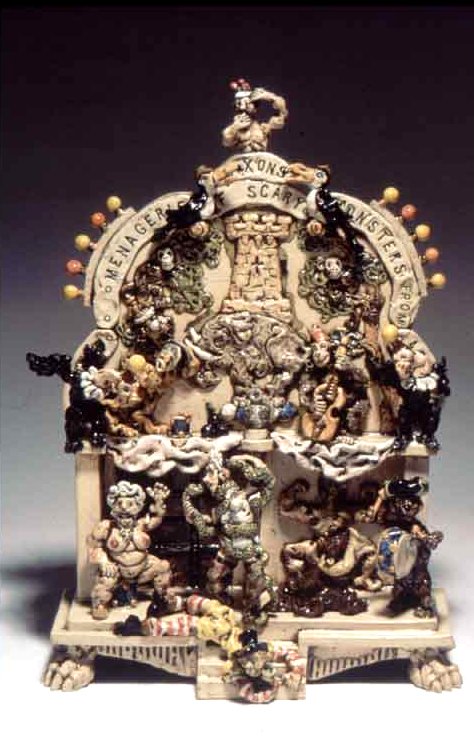
Selling contemporary work, whether to the general public or to specialist collectors, is undoubtedly one of the most complex aspects of a makers activities to categorise and define. Makers have all sorts of strategies and techniques for selling work, which may involve studio sales, galleries, agents, craft fairs, auctions, promotional data-bases and web-sites (or combinations of several of these) and this will vary depending on the type and value of work and its perceived status. The market for contemporary ceramics operates at a number of monetary levels, with a much larger client base for functional and relatively lower-priced work, compared to the market for expensive gallery pieces. My own ceramics (large-scale, non-functional, figurative and political) fall squarely into the latter category, and so my selling strategies have always made use of the gallery system and targeted both private and public collectors. Selling through galleries. I was fortunate (in some ways at least) to graduate in London in the mid-eighties, at the height of the Thatcherite economic boom and its associated loadsamoney culture. Looking back, this was something of a golden age for the crafts (albeit a short-lived one), with a healthy number of public and private craft galleries catering to an affluent yuppie clientelle. Early exhibitions in some of these galleries (Contemporary Applied Arts, Crafts Council Shop at the V& A, and Anatol Orient Gallery) established connections with galleries, curators and collectors which I have since worked hard to maintain and expand. The benefits of a good working relationship with a gallery are obvious; the gallery gives the maker artistic identity and status, access to a specialised collectors market, exhibitions and promotional opportunities. The gallery will also have a long-term interest in developing the career and reputation of the maker. (In my own case, these early exhibitions in London galleries also introduced my work to international collectors and galleries, particularly in the U.S.A., where I now make the majority of my sales to private collectors.) From a makers perspective, it is important to build both a strong individual identity and artistic credibility in order to become collectable. Galleries obviously have a role in this, as does recognition by organisations like the Crafts Council, participation in major survey exhibitions, catalogues and magazine articles. Collectors are undoubtedly influenced by a growing reputation and a strong P.R. profile. Galleries may also make sales directly to public collections in the U.K., as many national and regional museums and galleries maintain collections of contemporary ceramics. (I have also had some success in making direct sales to museums from the studio, though curators usually prefer to select from a body of work in an exhibition context.)The public sector operates rather differently in the U.S.A., where museums tend to build collections on the basis of donations from private collectors. Collectors motivations. Collectors of contemporary ceramics are, in my experience, motivated by passion rather than profit (though a shrewdly assembled collection can be a sound investment.) I have been invited to visit many major private collections in the U.K. and U.S.A. and I have always been impressed by the knowledge and enthusiasm (often bordering on obsession) of the collector. Individual motivations to collect are varied, and collections may be historical, stylistic, thematic, or may simply be intuitive and not categorised at all. Some collectors may concentrate on an individual or group of makers and follow their career development through a collection built up over many years, and this kind of regular patronage has obvious merits. Collectors can also be highly competitive, and often possess an astute eye for the strongest work. Collectors are often motivated by an interest in the artist as well as the work (particularly in the U.S.A.) and it is useful to develop this relationship attending conferences and trade fairs like SOFA Chicago can be important. It is also worth taking a pro-active role in researching who the collectors are and what they collect. (A few years ago I sold Dixons Menagerie to a Texan collector by matching this contemporary piece to a historical collection of Staffordshire figures.) Buying for the Crafts Council Collection. I have recently seen the collecting process from the other side of the fence, whilst acting as an adviser to the Crafts Council Collection Purchasing Committee. As well as an opportunity to make studio and gallery visits (and see some fantastic ceramics) over the last three years, the role has given me an insight into the responsibilities, opportunities and difficulties of building and maintaining a public collection of international significance on a limited budget. Although major pieces by Claire Curneen, Philip Eglin, Carol McNicholl, Nicholas Rena and Martin Smith (to name just a few) were collected over this period, this represented only a tiny fraction of the quality work available. Difficult choices had to be made, in an attempt to achieve a representative perspective. Perhaps this simply illustrates the collectors dilemma: so many great pots out there, not enough money to buy them all!
|
|
| back | |